Modern Verdure
Table Lamp

ID 2012 B- Lighting Project, Spring 2007
Overview
The lamp project was the first studio design project that resulted in a functioning product, not just a mockup. The final design features two cylindrical shades can be rotated by the user. Random patterns, intended to mimic light passing through leaves, cover the two shades and diffuse the light passing through them. This lamp is intended to be used as an accent or supplementary light, most likely placed on an end table.

Light Effects
The first project goal was to learn to manipulate transparency. My intent was to mimic the effect of sunlight filtering through leaves, but in a more diffuse manner. While both shades in the final used white paint to partially block the light, frost was added to the interior shade to obscure view of the bulb.
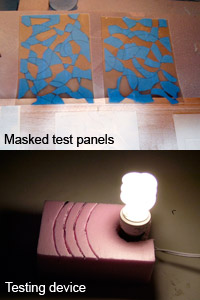
Several lampshade combinations were tested before the final was constructed. A quick testing device was made out of pink foam to hold test panels at set distances from the bulb (the same type of fluorescent bulb used in the final). Test panels were made using the same techniques as on the final model, but with different combinations of white paint and/or frost.
Test panels:
- White & clear
- Frost & clear
- White & frost
- Solid frost (for diffusion only)
Joining Techniques
The second aspect of the project was joining. As previous models were only mockups, "cheap" joining methods such as glue could be used. This project required the use of mechanical means of joining materials. The final prototype used screws in the base to attach rubber feet and the bulb socket. The seams of the shades were stitched together using clear plastic line.
Before finding that heat joining did not fulfill the project requirements, I had done testing to try to find a way to melt the lampshade seams. Different types of plastic and methods of heat application were tried and discarded- some combinations never reached sufficient heat, while others melted so fast that they burned nearly instantaneously. In the end, I arrived at a method which used a thin strip of aluminum to diffuse the intense heat of a soldering iron, allowing the heat to be applied over a large area, creating an excellent bond. One of the discarded methods was actually used in the end- accidental overexposure to a heat gun caused one plastic sheet to ripple, and this effect was utilized in the final to reduce the geometric appearance of the shades.
All site layout, graphics, and content © 2007 Jonathan Sheppard. Contact: shrakner2140@yahoo.com
This site is best viewed with Firefox or Safari.

